A four-day powerlifting program for intermediates: weekly plan and load adjustments
Momentum Coach ·
A four-day powerlifting program can fit two squat sessions, three bench sessions and two deadlift sessions without making every workout a max test. Start with manageable work, an effort target and a rule for choosing the next load.
Below is a sample week and a way to review it. This is an educational example written by Momentum, not a trial-tested program or an individual prescription. It assumes you already practice the three lifts and can estimate effort reasonably consistently.
Who this schedule suits
Four days make sense when you can sustain them for the block. If you regularly miss the fourth session, plan for three from the beginning. Here, “intermediate” means you need several weeks of observations to assess progress; it does not mean reaching a particular total.
You need a rack with safeties, a bench, a bar and plates. Use appropriate safeties or spotting. This example does not address returning from injury or pain that changes your movement.
The week: sets, reps and RPE
These are working sets, excluding warm-ups. RPE 7 roughly means three reps left; RPE 8 roughly means two. That estimate takes practice and varies between people and exercises.
| Day | Exercise | Sets × reps | Target effort |
|---|---|---|---|
| Monday | Competition squat | 3 × 5 | RPE 7 |
| Monday | Competition bench press | 3 × 6 | RPE 7 |
| Monday | Row | 2 × 8–12 | 2–3 reps in reserve |
| Tuesday | Competition deadlift | 3 × 4 | RPE 7 |
| Tuesday | Paused bench press | 3 × 5 | RPE 6–7 |
| Tuesday | Leg curl | 2 × 10–15 | 2–3 reps in reserve |
| Thursday | Paused squat | 3 × 4 | RPE 6–7 |
| Thursday | Competition bench press | 4 × 4 | RPE 7–8 |
| Thursday | Pulldown or assisted pull-up | 2 × 8–12 | 2–3 reps in reserve |
| Saturday | Paused deadlift | 2 × 4 | RPE 6 |
| Saturday | Triceps pushdown | 2 × 10–15 | 2–3 reps in reserve |
| Saturday | Familiar abdominal exercise | 2 sets | Keep technical control |
Pauses give you practice in specific positions with manageable loads. They are optional: if unfamiliar, use your usual movement with a lighter load. Saturday is deliberately short. Each exercise needs a purpose; you do not need more exercises just to make the day count.
Start with roughly 3–5 minutes between main-lift sets and allow longer if needed. Accessories can use shorter rests. Fit them around your available time without rushing the main work.
Choosing the first load
Refer to a recent session with the same movement and repetitions. Warm up gradually and choose a conservative first working set. An old personal best or a calculator cannot tell you exactly how today's set will feel.
Suppose you planned bench press for 3 × 6 at 80 kg and RPE 7, but the first set feels like RPE 9. Check rest, execution and loading. If effort remains clearly above target, try a small reduction and reassess. You do not have to finish all three sets with the original weight.
Our RPE calculator estimates relationships between weight, reps and effort. Round to available plates and check the estimate under the bar.
Progression across four weeks
Keep exercises consistent so you can compare sessions. This sequence illustrates decisions; it does not require weekly load increases.
| Week | Action | What supports the next step |
|---|---|---|
| 1 | Find loads that match the prescribed work and effort | Record each set and its RPE |
| 2 | Repeat or add the smallest practical increment | Week 1 was completed with consistent execution and room left |
| 3 | Keep the structure and reassess loads | Avoid repeated increases when effort already exceeds target |
| 4 | Review before continuing | Compare performance, attendance and recovery |
Moving from 80 kg to 82.5 kg at similar effort is useful evidence. Moving from RPE 7 to RPE 9 at the same time changes the task. Repeating 80 kg with better control or less effort can also matter.
Week 4 does not automatically require a deload or a max test. Repeated performance declines alongside poorer recovery are reasons to review the work. Read our deload guide and the limitations of estimated 1RM.
When a session goes badly or you miss it
One bad set is not enough to redesign a block. Review what happened and change one variable at a time. If you miss a day, avoid combining two full workouts by default: use the missed-training guide.
If progress remains unclear across several completed weeks, review actual effort, tolerable volume and specificity before adding exercises. The self-coached powerlifting guide offers a weekly review process.
Using this example with Momentum
Momentum lets you record weight, repetitions and RPE and review your history. This article's program does not import automatically. Set up a block for your schedule, goal and experience, then compare the plan with the work you complete.
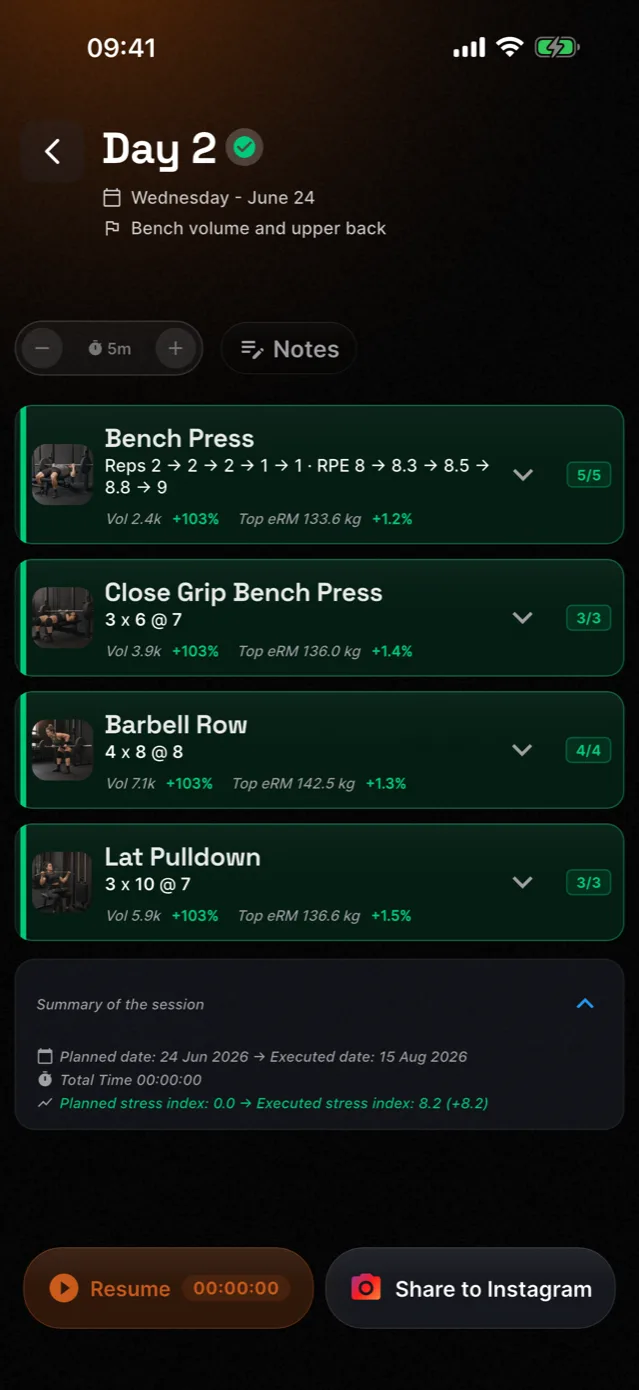
Archive screenshot from August 2026, version 1.8.28. The current interface may differ. It illustrates information worth retaining when reviewing a session.
Plan your training with Momentum. You lead the block; the app helps you plan, understand and adjust.
Frequently asked questions
Are four days better than three?
Not necessarily. Four days distribute the work differently, but three sustainable days can be more useful than four you cannot complete. Volume, effort and recovery also affect the comparison.
Do I need a heavy single every week?
Not for this example. Singles can be useful in other contexts, but a powerlifting program does not have to include them every week.
Can I use percentages instead of RPE?
Yes, as a starting point. Adjust when the percentage produces an effort very different from the target. Lifters do not all perform the same number of reps at the same percentage of 1RM.
Sources and scope
The schedule and decision rules are Momentum's editorial example. Autoregulation in Resistance Training: Addressing the Inconsistencies provides background on autoregulation methods. It does not validate this particular program or demonstrate results from Momentum.