Missed a week of powerlifting? How to resume your program
Momentum Coach ·
If you missed a week of powerlifting, first consider why, how long the break lasted and how training feels when you return. You do not need to make up every missed set or jump to heavier loads because the calendar moved on.
This guide addresses schedule and travel interruptions for established lifters. Returning after illness, injury or persistent symptoms involves different considerations and professional assessment when appropriate.
One missed session is different from a missed week
| Situation | First review | Scheduling option |
|---|---|---|
| One session missed, no nearby meet | Available days and spacing between lifts | Shift the sequence if recovery remains workable |
| Several sessions missed | Completed work and response on return | Resume from a recent manageable exposure |
| The fourth session is almost always missed | Whether four days are realistic | Plan three days rather than constantly catching up |
| A meet is close | Remaining days, specific practice and recovery | Review the final preparation without compressing weeks |
None of these options requires recovering all the missed volume. The aim is to return to a sustainable sequence.
When you miss one day
Suppose you train Monday, Tuesday, Thursday and Saturday and miss Thursday. If Friday is available, you might move that session and reconsider Saturday according to overlapping work. Do not automatically merge two full sessions into Saturday.
If moving it creates a sequence of demanding work without enough recovery for you, prioritize key sessions and omit less important work. Record the change so the next week has context.
When you miss a full week
Use the last comparable session as a reference, not an obligation. Follow your usual warm-up progression and choose a conservative first working set. Observe effort, control and tolerance before deciding the rest of the session.
There is no universally correct load reduction. A week with normal sleep and activity differs from a week of illness, flights and limited food. If warm-ups are much harder than expected, adjust load or work; avoid making the return a max test.
A squat example
Before travelling, you completed 3 × 5 at 120 kg around RPE 7. On returning, you could start below that weight and assess the first set. If it is harder than expected, adding weight solely to reach the previous number is not a useful target that day.
If the work feels familiar, you still do not need to add last week's missing sets. Record the session and use it to inform the next exposure. These numbers illustrate a decision, not a personal recommendation.
Repeat the week or continue?
Repeating can make sense when the next week assumes work you did not complete and there is no fixed deadline. Continuing may be reasonable after a small interruption if the next prescriptions remain appropriate. Either way, check actual effort before retaining the written load.
A competition date does not move with your training schedule. Reconsider which specific practice matters most and what you can omit. Compressing two weeks into one does not recreate the missing recovery time.
What to record during the first sessions back
- Last completed work before the break and days away from training.
- Actual weight, reps and RPE on return.
- Changes to variation, equipment or rest.
- Work you omitted or moved.
- The response at the next exposure to the same lift.
Compare several exposures before concluding that strength has declined. One different session does not establish a lasting change in capacity. Read about interpreting estimated 1RM as well.
If it happens every month, change the structure
Repeated scheduling problems may call for a program that fits your actual availability. Three days or a short fourth day can reduce dependence on time you rarely have.
Our four-day example includes a short fourth session, but it may not be your solution. The self-coached training guide explains how to review attendance and the plan.
Keep the context in your training log
Momentum lets you review the block and record the session you actually completed. Check dates and loads before continuing. Do not assume a calendar screen means a missed session has already been handled automatically.
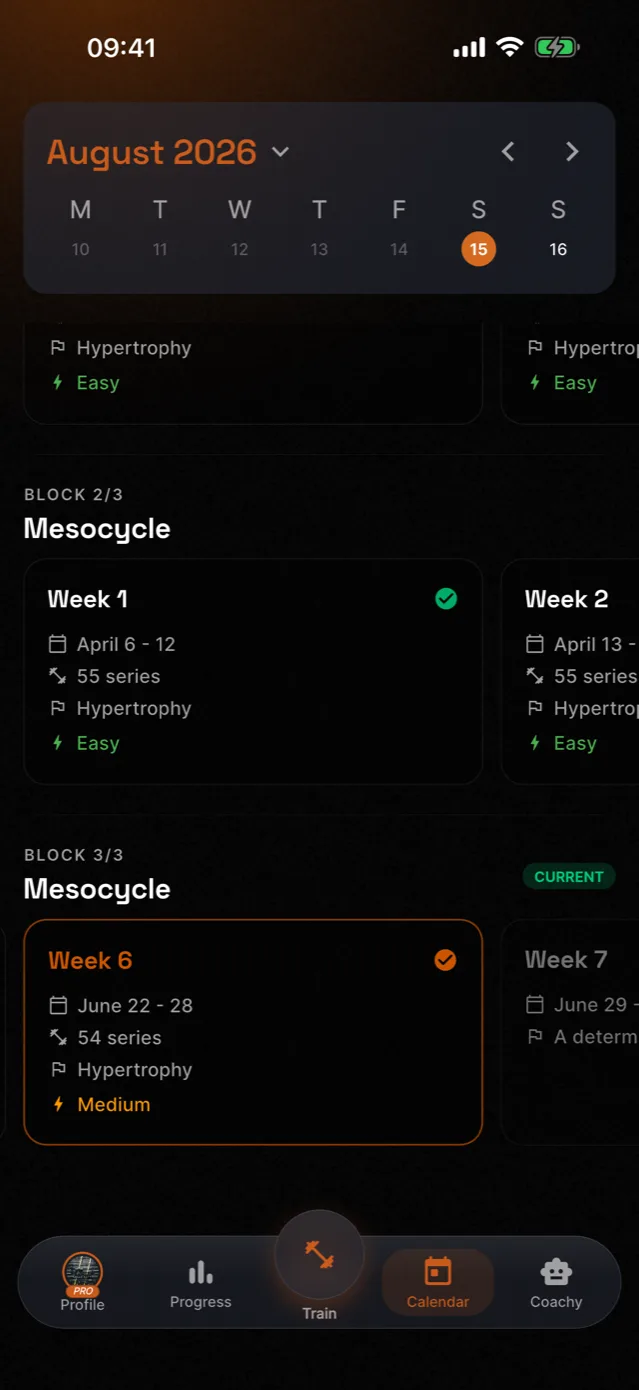
Archive screenshot from August 2026, version 1.8.28. It illustrates block organization; the current interface may differ.
Organize your next block in Momentum and retain the changes so you can review them.
Frequently asked questions
Do I need a deload after a week off?
Not automatically. An interruption and a planned deload are different situations. Base the return on why you stopped and how you respond, not just the calendar.
Can I double sessions to catch up?
Do not make that the default. First review which work matters most and the recovery available. A missed session does not create a debt of sets.
What if something hurts on return?
Do not use this guide to manage persistent or intense pain, or pain that changes your movement. Stop the provoking exercise and seek appropriate assessment.
Sources and scope
Autoregulation in Resistance Training provides context for adjusting training to individual response. It does not prescribe a seven-day return protocol. The scheduling options here are editorial examples, not clinical rules or universal instructions.