Self-coached powerlifting: how to plan, review and adjust your training
Momentum Coach ·
Self-coached powerlifting needs a simple system: choose an appropriate plan, record what you actually do and review that record before changing the program. An app can organize the work; decisions still need context.
This guide is for lifters who already practice the squat, bench press and deadlift and want to manage their training. You do not need to invent a method. A published program with clear progression rules can be a useful starting point.
Choose a block you can complete
Define a near-term goal: build work capacity, practice the bench more often or prepare for a meet on a known date. Then establish how many days and how much time you really have. Choose an initial workload reasonably close to what you currently tolerate.
Moving from three sessions to five, changing exercises and doubling sets at once makes the response hard to interpret. More gradual changes give you a clearer reference.
For a concrete structure, see our four-day intermediate example. It is adaptable, not a requirement for training independently.
What to record in each session
A short, consistent log is more useful than a long list of metrics abandoned after two weeks.
| Record | Why it helps | Example |
|---|---|---|
| Exercise and variation | Compare similar tasks | Paused bench, same grip |
| Weight, sets and reps | Know what you completed | 3 × 5 at 85 kg |
| RPE for each set | Interpret performance alongside effort | 7, 7.5 and 8 |
| Changes from the plan | Understand deviations | One set skipped due to time |
| Relevant context | Avoid blaming everything on programming | Less sleep; shorter rests |
Filming some sets from a consistent angle can help you review execution and range of motion. It cannot diagnose injury or turn technique into an objective score.
A ten-minute weekly review
Set aside time outside the gym. Look at each main lift separately and answer:
- Did I complete the planned sessions and sets?
- Was effort near the target, or did it repeatedly increase?
- Did I lift more weight or reps under comparable conditions?
- What changed outside the program: schedule, sleep, rest or equipment?
- Which single decision will I maintain or review next week?
Estimated 1RM can summarize part of the log. However, comparing paused bench with touch-and-go can confuse an execution change with progress. A higher estimate does not guarantee a successful meet attempt.
When to keep the plan and when to adjust
| Observation | Reasonable first response | Avoid |
|---|---|---|
| One unusually poor session | Record context and observe the next | Switching programs that evening |
| Repeated efforts above target | Review loads, rest and total work | Increasing weight only because the sheet says so |
| The fourth session is regularly missed | Build a sustainable three-day schedule | Accumulating missed workouts |
| Stable progress and acceptable recovery | Continue the approach | Adding volume without a reason |
| Persistent pain or altered movement | Seek professional assessment | Choosing random variations as a solution |
These are prompts for reviewing a plan, not diagnoses of what caused each problem.
Example: three weeks of bench press
Imagine 3 × 5 at 85 kg. Your last set is RPE 7.5 in week one, 8 in week two and 9 in week three. The load stays the same while effort rises.
Before adding 2.5 kg, check whether you shortened rest periods, changed the pause or added another pressing session. If conditions are comparable and the pattern continues, consider temporarily reducing work or load and observing the response. Changing frequency, volume and exercise simultaneously removes your reference.
If your schedule caused the interruption, read how to resume a block. For a planned reduction in demands, see the deload guide.
When a coach can help
Training without a coach can be a long-term choice. A one-off review of technique or programming is also compatible with directing your own training.
A coach offers an outside perspective when you cannot identify a pattern, are preparing for a first meet or have constraints you cannot integrate. An app does not have the same responsibility or contextual understanding as a professional working with you.
Where Momentum fits
Momentum brings programming, logging and history together for training review. Coachy is an AI assistant within the product. Interpret its suggestions alongside what you know about your session. It does not guarantee progress or replace professional assessment.
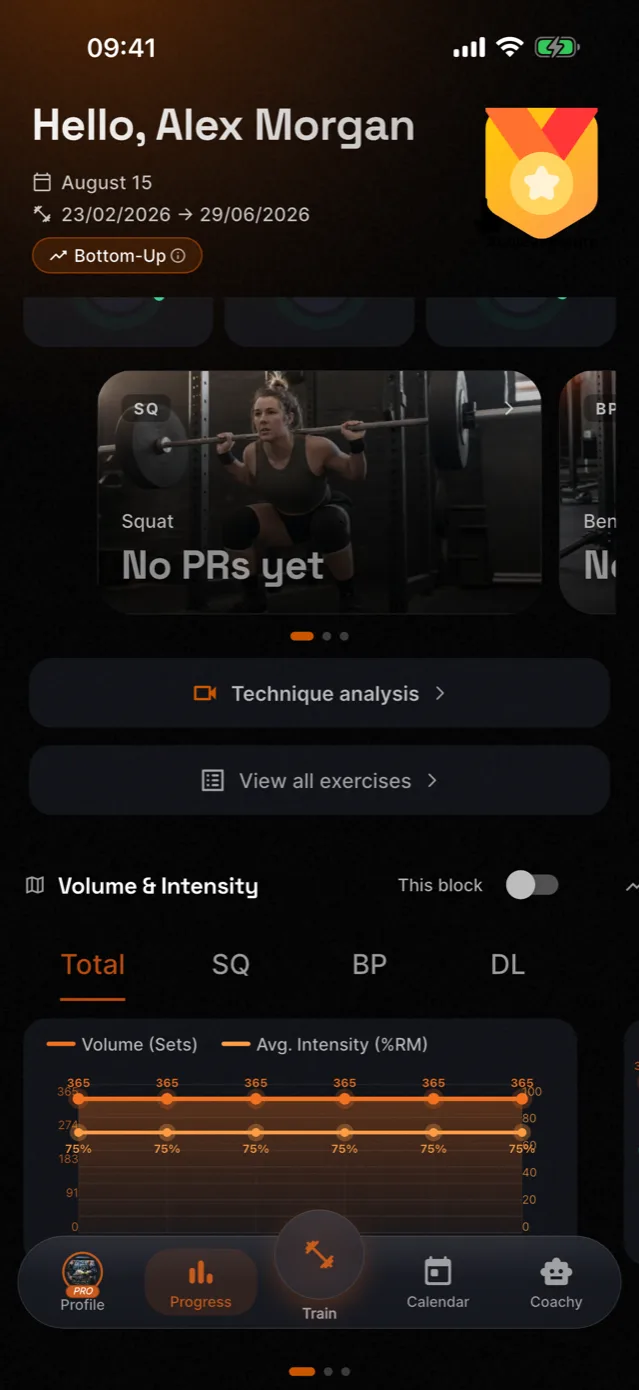
Archive screenshot from August 2026, version 1.8.28. It illustrates tracking, not a user's result or evidence of effectiveness.
Explore Momentum to keep your block and log together. If you are still choosing software, compare apps for self-coached powerlifters.
Frequently asked questions
Must I learn programming from scratch?
No. Start with a program that explains its rules and record your response. Reviewing a plan can be a more manageable first step than designing the whole thing.
Is a spreadsheet enough?
It can be, if it supports logging, review and progression rules. Choose something you understand and will use consistently. An app adds convenience and context, not guaranteed outcomes.
How often should I change programs?
There is no universal interval. Set review points and assess attendance, performance and goals. Changing after every difficult week makes the block hard to evaluate.
Further reading
The Stronger by Science strength guide provides context on strength development. This article's checklists and examples are Momentum's editorial proposals, not validated fatigue-diagnostic tools.